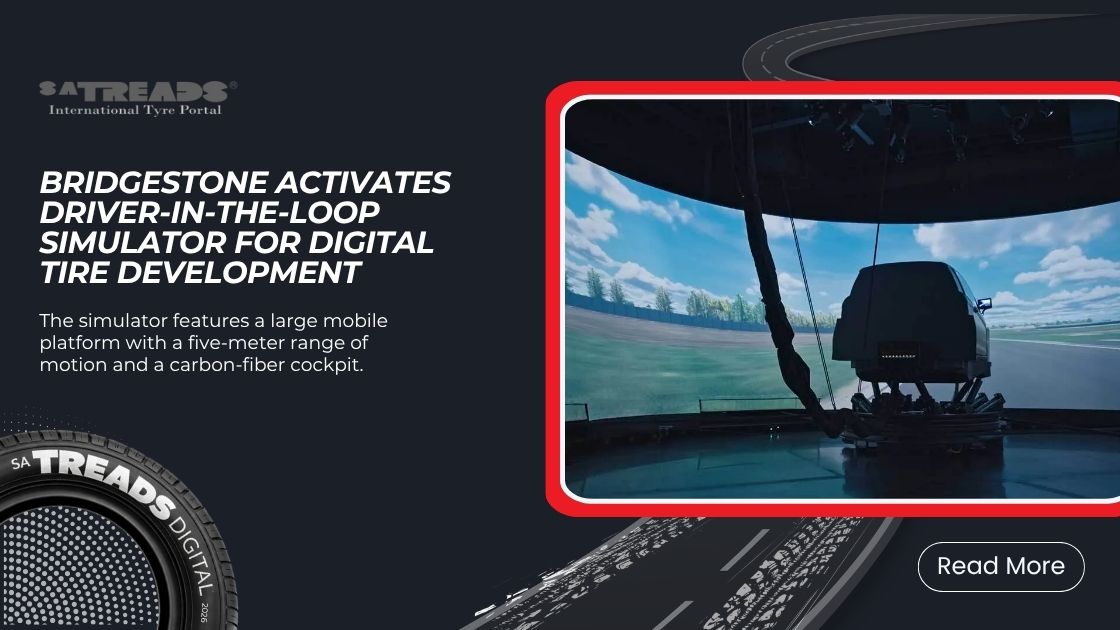
The simulator features a large mobile platform with a five-meter range of motion and a carbon-fiber cockpit.

Bridgestone announced that its driving simulator is now fully operational at the company’s R&D center near Rome, Italy. The VI-grade DiM500 Driver-in-the-Loop (DiL) simulator enables the company to assess tire performance in a virtual environment.
“Bridgestone is already considered a pioneer in digital tyre development – leveraging Virtual Tyre Development for more than a decade. By integrating the driver into the digital development cycle, this investment adds a crucial new piece to our evolving ecosystem,” said Mattia Giustiniano, R&D senior vice president at Bridgestone West. “The simulator’s introduction marks a significant step in enhancing the efficiency and sustainability of our R&D processes, while unlocking unprecedented opportunities to foster innovation.”
Bridgestone Driving Simulator Capabilities
The simulator features a large mobile platform with a five-meter range of motion and a carbon-fiber cockpit. The system immerses the driver in an environment that imitates real-world driving. The motion range reproduces forces equivalent to physical tests for analysis.
Bridgestone said it combines high-fidelity simulations with subjective driver feedback, historical data and artificial intelligence technologies. The company said this system enables earlier and more accurate design decisions.
Engineers can evaluate more tire specifications than with traditional physical testing. The system also allows testing in less time and across a broader range of conditions. Physical testing remains part of the process and can serve for final validation.
Prototype Reduction and Environmental Impact
The DiL simulator reduces the need for physical tire prototypes. Bridgestone said it expects the system to save up to 12,000 experimental tires each year, reducing environmental impact.
Bridgestone said its Virtual Tire Development technology already enables up to a 60% reduction in raw material consumption and CO2 emissions during development of original equipment tires.
Time to Market and Industry Collaboration
Bridgestone said the driving simulator also supports faster product development. The technology allows engineers to develop tires and vehicles in parallel.
Bridgestone said this approach supports closer collaboration with vehicle manufacturers. It also strengthens the company’s ability to custom-engineer tires to maximize each vehicle’s performance potential.
Evaluation Scope
The simulator mainly supports dry handling evaluations. Bridgestone is expanding its capabilities to assess a broader range of performance conditions.
The work is backed by the company’s global investment in R&D. Bridgestone said the effort aims to meet the evolving needs of vehicle manufacturers and end users.