Infrastructure projects, Right to Repair and tariffs guide 2026 risks and opportunities for the industry.
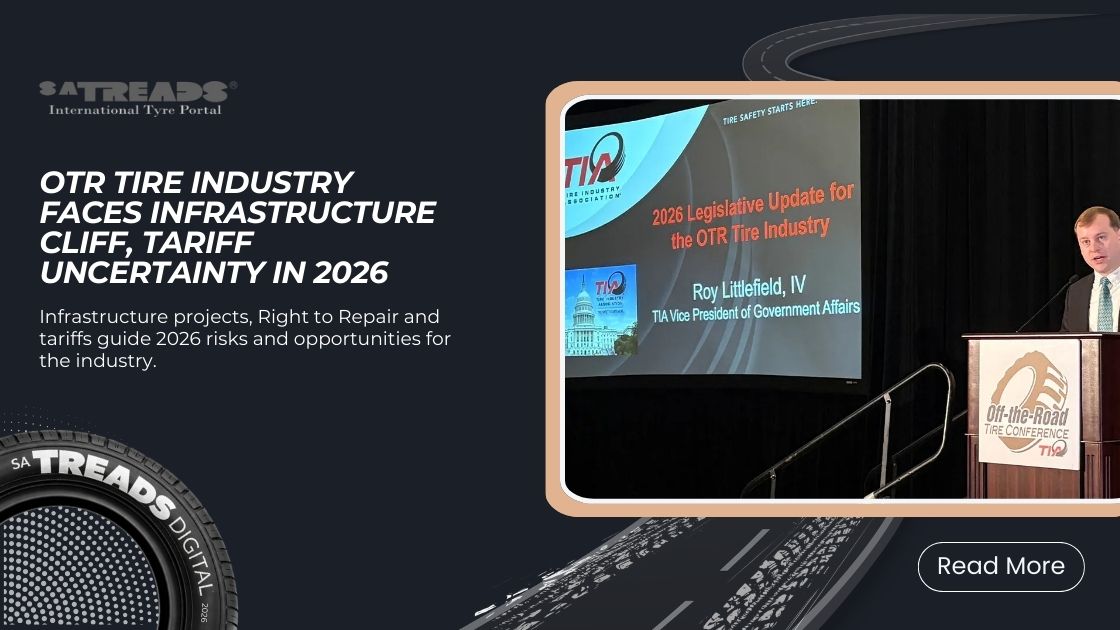
During the 71st OTR Tire Conference in Orlando, Florida, Roy Littlefield IV, TIA’s vice president of government affairs, laid out the legislative characteristics facing the off-the-road tire industry in 2026.

With the 119th Congress in its final year, and in an election year with the mid-terms this fall, he said change in Washington is fast approaching – and will impact the industry along with it.
“[There’s] a lot of noise, a lot of uncertainty, and a lot of competing priorities in Washington and in state capitals across the country, but it also means opportunity,” he said. “Lawmakers are listening more closely. They’re paying attention to how policies affect real people, real jobs, and real businesses back home.”
For the OTR industry, that means infrastructure, mining, and industrial expansion will need the products, like OTR tires, to keep them running. They are equipment-intensive industries, after all, which is always a good sign for the industry.
“The off-the-road tire industry doesn’t live in theory,” Littlefield said. “When policymakers talk about economic growth, infrastructure investment, energy independence, or new technology, none of those goals can happen on their own. They only become real when equipment is moving, materials are being hauled and work is underway.”
Infrastructure Funding
Littlefield said the most immediate legislative sticking point in the near-term is infrastructure. The current surface transportation authorization expires Sept. 30, which he said puts future federal funding on the table.
“When Congress debates highways, bridges, ports, and other major infrastructure projects, those discussions aren’t just numbers on a spreadsheet,” Littlefield said. “They represent real jobs, real schedules, and real economic activity.”
He reminded attendees that, though the past five years saw historic infrastructure investment, that momentum can’t stall.
Littlefield said those infrastructure dollars should be used smarter. He pointed to rubber-modified asphalt and tire-derived aggregate as cost-saving solutions. In fact, TIA estimates that national adoption of rubber-modified asphalt could save the federal government $6 billion per year.
“These products don’t just stretch taxpayer dollars,” he said. “They improve performance, durability, and long-term outcomes.”
Right to Repair and Regulatory Hurdles
While federal spending may dominate infrastructure, and therefore OTR, conversations, Littlefield said the rules governing how businesses operate can have just as much impact on the OTR sector.
He pointed to Right to Repair as one of those examples.
“For the OTR tire industry, Right to Repair is not a theoretical debate. It’s practical,” Littlefield said. “It keeps machines running, reduces downtime and helps businesses control costs.”
In many OTR applications, equipment operates in remote locations, which means delays can turn into lost productivity. When equipment goes down, Littlefield said operators have to be able to diagnose issues and complete repairs without waiting on access to the proper tools.
“When equipment goes down, often in remote locations, operators need to diagnose problems, make repairs, and get back to work quickly,” Littlefield said. “That means access to tools, software, parts, and information.”
Beyond repair access, Littlefield said TIA is working to reduce regulatory burdens that add cost. He referenced increased use of the Congressional Review Act to revisit federal regulations, which he says can improve regulatory efficiencies without reducing focus on environmental or safety protections.
“Let me be clear,” he continued, “Those safeguards matter. We are calling for regulations that make more sense, rules that are easier to follow, permits that move faster and fewer overlapping requirements that drive up costs without improving results.”
Tariffs and Trade Uncertainty
Littlefield said that, for an industry that depends on a complex international supply chain, tariffs can have ripple effects. Especially when it comes to manufacturer pricing and dealer inventory decisions.
“Tariffs remain an active part of the administration’s broader trade and negotiating strategy on the global stage,” he said. “As an Association, we do not take a one-size-fits-all position on tariffs. Our membership is diverse. For some members, tariffs may create challenges around cost, availability and planning. For others, they may provide competitive advantages or help support domestic production.”
Regardless of members’ stand on tariffs, Littlefield said every member can agree on the need for stability surrounding them. Or, at least a general understanding on how they’ll affect pricing and infrastructure projects.
“What’s clear is that changes in trade policy can move quickly and create uncertainty for businesses trying to plan, invest and serve their customers,” Littlefield said. “Our role is to advocate for clarity, predictability and sufficient lead time so businesses can adjust and make informed decisions.”
Tax Policy Updates
Littlefield also said recent tax policy has been a positive development for the industry. The recently passed “One, Big, Beautiful Bill Act” includes cuts that should help with cash flow and infrastructure reinvestment, he said.
“These provisions improve cash flow, encourage reinvestment, and provide greater certainty for long-term planning,” he said. “For many business owners, the permanent estate tax exemption levels are especially important.”
At the state level, Littlefield said legislative activity is very active. In fact, TIA is tracking more than 150 state bills that he said could significantly impact the tire industry.
“While some of these bills could benefit us, many more could harm our industry,” he said. “Remember, local representatives are paying attention, so we encourage you to stay vocal in your states when these issues arise.”