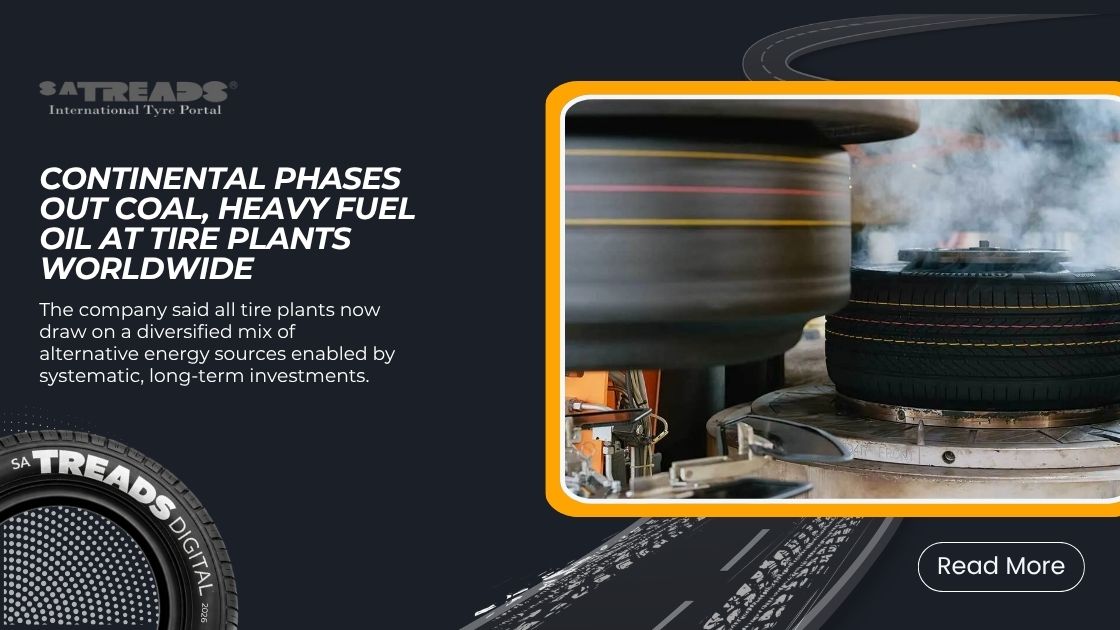
The company said all tire plants now draw on a diversified mix of alternative energy sources enabled by systematic, long-term investments.

Continental said its tire production has reached a sustainability milestone, as it phases out coal and heavy fuel oil across all tire production sites. Since January, all plants have adopted alternative energy sources to generate the steam required for tire manufacturing and heating, including biomass, biogas, electricity from renewable sources, and alternative fuels such as liquefied petroleum gas (LPG) and natural gas.
“For us, coal and heavy fuel oil are a thing of the past. The future increasingly lies in renewable energies,” said Dr. Bernhard Trilken, head of manufacturing and logistics at Continental Tires. “By relying on a smart mix of energy sources – increasingly renewable and ideally generated directly on site – we are making our manufacturing more independent and therefore more resilient.”
Coal and Heavy Fuel Oil Phased Out Globally
Until the early 2020s, seven of Continental’s 19 production facilities worldwide used coal and heavy fuel oil for steam generation. These sources ensured thermal output and operational reliability in regions with limited gas or electricity infrastructure. The company said all tire plants now draw on a diversified mix of alternative energy sources enabled by systematic, long-term investments.
A significant share of energy in tire manufacturing supports heating processes such as vulcanization, which gives rubber its elastic properties. Steam for this step was long produced from fossil-based sources. Continental said advanced electric technologies now make the process more flexible and energy efficient.
Renewable Electricity and Emissions Reductions
Since 2020, Continental has purchased electricity exclusively from renewable sources. The company continues to expand on-site renewable generation. It reports reducing the greenhouse gas intensity of production by more than 10% in 2025 compared to the previous year, and by about 70% compared to 2019.
By switching to lower-emission energy sources, Continental said it has cut around 180,000 metric tons of CO2 from tire production over the past four years.
Energy Changes in Continental Tire Production
Today, Continental uses a combination of energy sources to reduce CO2 emissions from tire production. These include biomass, biogas, electricity from renewable sources, and alternative fuels such as LPG and natural gas.
“We have significantly reduced our production-related CO2 emissions, thanks to continuous investments in electrification and changing the energy sources used for heat generation at our plants worldwide,” said Henning Mühlenstedt, head of future technologies and sustainable infrastructure at Continental Tires.
Regional Examples in South Africa, Sri Lanka and Czech Republic
At the Gqeberha, South Africa, plant, coal previously supported steam generation. The site now uses biomass, with LPG covering remaining demand. In Kalutara, Sri Lanka, a second biomass boiler commissioned last year eliminated heavy oil use. The plant now generates all steam from renewable biomass.
In Otrokovice, Czech Republic, Continental worked with its regional energy supplier to align steam generation with the company’s climate targets. The local power plant shifted its fuel mix from coal to biomass and natural gas. This change allows Continental’s tire plant to receive predominantly biomass-generated steam. Surrounding communities will also receive district heat from a lower-emission mix.
Ongoing Sustainability Efforts and Recognition
Continental said the transition to alternative energy sources forms part of broader efforts to improve energy efficiency and increase renewable energy use in production.
The independent organization CDP awarded Continental an A- rating in 2025 for climate transparency and CO2-reduction measures.