
The company developed the system under its HAICoLab AI utilization concept.

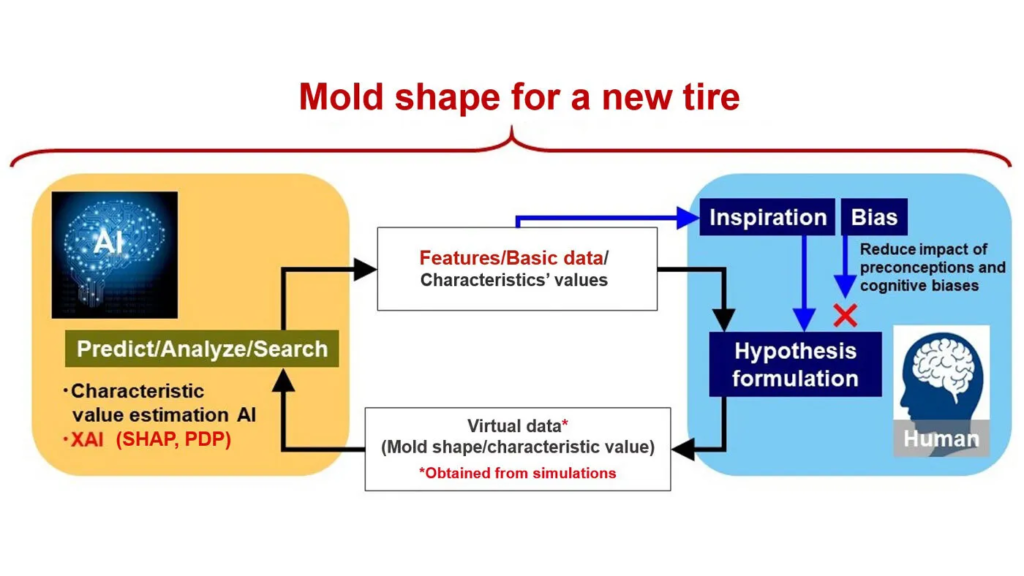
Yokohama Rubber announced it developed a proprietary AI tire mold design system. The system uses finite element method (FEM) simulations and the company’s AI technology and is designed to supplement staff knowledge and streamline mold design, it said.
It provides data on how mold design factors affect tire characteristics through virtual experiments.
According to Yokohama Rubber, the tire mold design system increases development speed. It also reduces costs and rework. The system helps teams analyze relationships between mold parameters and tire performance targets from multiple perspectives.
Tire Mold Design System Overview
The company developed the system under its HAICoLab AI utilization concept. Yokohama Rubber launched HAICoLab in October 2020 to improve development processes.
Mold design has a major impact on key tire characteristics. Achieving a full understanding of design-factor relationships has required trial production and follow-up evaluations. These steps are costly and time-consuming.
Previous approaches also relied on experienced staff. This reliance created differences in mold design accuracy and timelines based on individual experience.
HAICoLab stands for “Humans and AI Collaborate” for digital innovation. It also refers to a laboratory for joint research by humans and AI.
How the System Works
The system uses automated simulations and AI-based prediction and visualization. It generates a large number of tire FEM models with different mold shapes. It then calculates tire characteristics in a virtual environment.
These calculation results serve as training data. The system builds an AI surrogate model to predict relationships between mold design factors and tire characteristics.
The system applies explainable AI methods. These include SHAP (SHapley Additive exPlanations) and PDP (Partial Dependence Plots). These tools allow development staff to visualize the impact of mold design factors. Staff can determine how much to adjust each factor to meet target characteristics.