The global tyre industry is entering a new era of growth, driven by rising demand for smarter, more sustainable and higher-performance products. While short-term challenges such as tariffs and raw material costs remain, vehicle manufacturers continue to push for innovation – especially in larger rim sizes, electric vehicle tyres and advanced premium models. According to the latest Smithers report, these trends are set to fuel strong market expansion through to 2030, reshaping how tyres are designed, manufactured and used worldwide.

Despite short-term uncertainty linked to tariffs and raw material pricing, vehicle OEMs continue to demand innovation and sustainability in tires, including for more larger rim sizes and EV-specific models. According to the new Smithers market report – The Future of Global Tires to 2030 – this will propel demand forward at a 5.4% compound annual growth rate (CAGR) to reach $367 billion in 2030. Simultaneously volumes will increase at a 4.0% CAGR to over 3.1 billion units in 2030. This, according to Smithers Report.
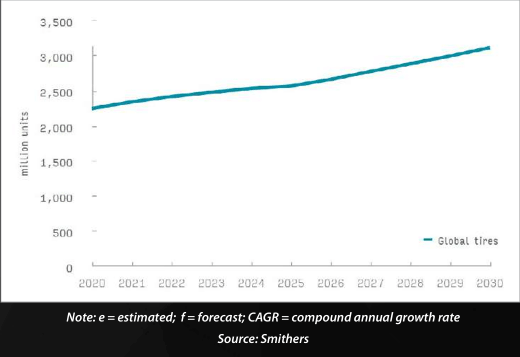
Despite short-term uncertainty linked to tariffs and raw material pricing, vehicle OEMs continue to demand innovation and sustainability in tires, including for more larger rim sizes and EV-specific models. According to the new Smithers market report – The Future of Global Tires to 2030 – this will propel demand forward at a 5.4% compound annual growth rate (CAGR) to reach $367 billion in 2030.
Simultaneously volumes will increase at a 4.0% CAGR to over 3.1 billion units in 2030. This, according to Smithers Report. The main catalyst will be the development of more premium, specialized road tires for passenger and commercial vehicles. These account for 21.5% of volume demand in 2025, but will grow at 10.0% year-on-year across the next five years. The segment is diversifying with a wide range of SUV, winter, all-season, green, EV, and run flat models – allowing more established tire companies to leverage R&D innovations.
Passenger light truck (PLT) tires remain the most important market segment, accounting for over two thirds (67.6%) of contemporary demand by volume, ahead of motorcycle tires (21.3%), and truck and bus radials (9.0%). A very large installed vehicle parc will support generally healthy PLT replacement across 20252030, even if OE sales are reduced in the short term; aging car fleets and extended vehicle replacement cycles in mature markets will make replacement channels more important. Simultaneously low rolling resistance (LRR) tires will grow in popularity, calling for design innovations that improve fuel efficiency, without compromising traction and treadwear.
Across the Smithers forecast period, consumption of tire raw materials will increase from 57.2 million metric tons in 2025 to 67.4 million metric tons in 2030. Materials suppliers will feel parallel pressure to develop more sustainable higher-performance rubber grades and reinforcement materials. As more EV tires are sold this will create new revenue from polymer noise-cancelling foams. Alongside electrification, automotive production is increasingly moving toward more autonomous features and softwaredefined vehicles (SDVs).
This is generating new opportunities for smart tires carrying sensors to provide real-time data on road surfaces, inflation, and wear. Tire makers are increasingly tapping this data to deliver more intelligent, enhanced tire maintenance services for commercial vehicle fleets.