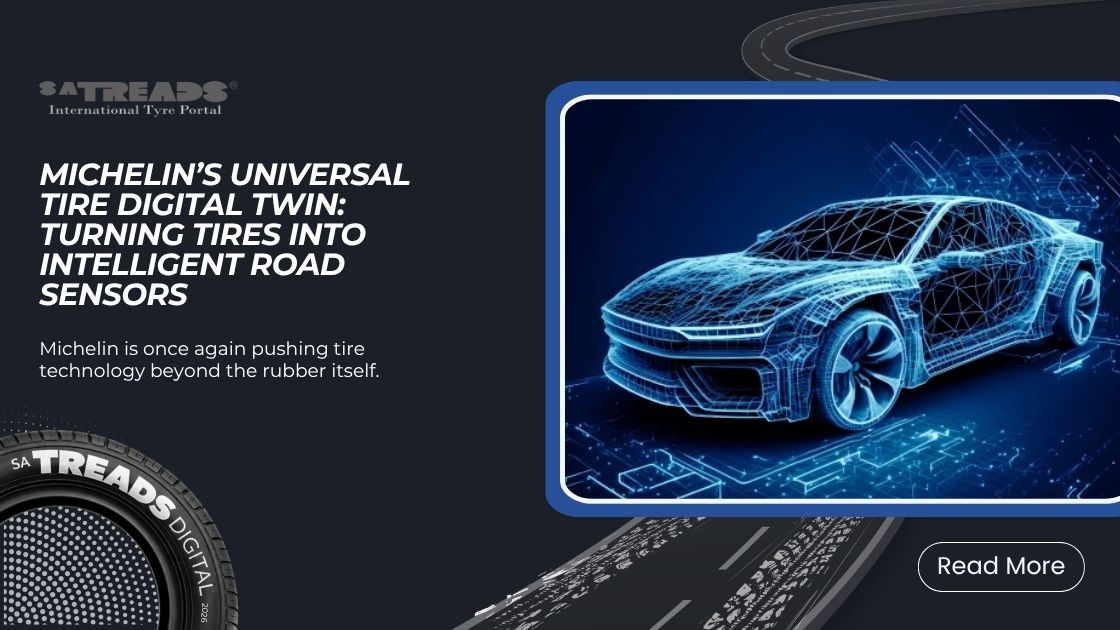
Michelin is once again pushing tire technology beyond the rubber itself. With its universal tire digital twin, the company is introducing a software-driven innovation designed to make driving safer, smarter and more predictable.

At its simplest, Michelin’s tire digital twin is a virtual model of a tire. It continuously estimates and predicts the condition of the tire by using existing vehicle data, advanced algorithms, tire physics, artificial intelligence and Michelin’s long-standing knowledge of tire behaviour. Michelin says the system can work without adding physical sensors inside the tire, and is designed to be compatible with all tire brands and vehicle types.
For the driver, that means the tire becomes more than a passive contact point with the road. It becomes a source of real-time intelligence.
How the Michelin Digital Twin Works
Modern vehicles already collect large amounts of data through onboard systems. Michelin’s digital twin uses this information to estimate key tire-related conditions such as pressure, wear, load, grip and driving conditions.
Instead of simply sending a warning after a problem appears, the system is designed to help the vehicle understand what is happening at tire level in real time. Michelin describes the solution as an embedded “brain” that can interact with vehicle systems to improve performance, safety and predictability.
This is especially important as vehicles become more software-defined. In these new vehicle architectures, performance, safety functions and user experience can increasingly be improved through software throughout the life of the vehicle.
Why It Matters for Safety
The tire is the only contact point between the vehicle and the road. That makes accurate tire intelligence critical.
Michelin says its digital twin can help vehicles anticipate grip levels, support braking performance, monitor pressure, detect slow leaks, estimate load and assist with predictive maintenance. The technology is also linked to future capabilities such as rolling resistance and grip estimation, which may help identify hydroplaning risks.
In practical terms, this could help a vehicle respond more intelligently in difficult driving conditions. It could also support advanced driver assistance systems such as ABS and ADAS by giving them more accurate information about the tire’s real-world condition.
Michelin has already pointed to its partnership with Brembo and the SENSIFY braking system as an example of how tire data can improve braking performance. According to Michelin, integrating the tire’s actual state into braking algorithms has shown shorter braking distances of up to four metres and improved stability during hard braking.
No Extra Tire Sensors Required
One of the most important parts of Michelin’s announcement is that the system does not require additional tire-mounted sensors.
Instead, the digital twin uses data already available from the vehicle. Michelin says this makes the solution easier to deploy and more universal, because it can work across different tire brands, vehicle brands and vehicle types. This includes passenger cars, trucks and even autonomous shuttles.
That universality is what separates this from many connected tire systems that rely on dedicated hardware inside the tire.
Predictive Maintenance and Longer Tire Life
The digital twin is not only about safety. It also has a maintenance and sustainability benefit.
By continuously estimating tire condition, the system can help predict when tires are approaching the end of their useful life, when pressure may need attention, or when a slow leak is developing. Michelin’s connected-solutions article highlights SmartWear for tire wear measurement and end-of-life prediction, as well as pressure monitoring and slow leak detection.
For fleet operators, manufacturers and future mobility platforms, this could help reduce downtime, improve maintenance planning and extend tire life. For everyday drivers, it could mean fewer surprises and better guidance on when action is needed.
The Bigger Picture: Tires in the Software-Defined Vehicle Era
Michelin’s digital twin shows how the role of the tire is changing.
In the past, tire innovation was mostly about tread design, compound technology, durability and rolling resistance. Those areas still matter, but tires are now becoming part of the vehicle’s wider data ecosystem.
Michelin says it has spent more than ten years developing the technology, supported by patents and testing over several million kilometres. The company is positioning the digital twin as a key technology for the future of software-defined and autonomous vehicles.
As vehicles become increasingly connected, the tire can no longer be viewed as a simple mechanical component. It is becoming a live source of data that helps the vehicle make better decisions.
What This Means for the Tire Industry
For the tire industry, Michelin’s universal tire digital twin represents a major shift.
It moves tire value beyond the physical product and into software, data and predictive intelligence. It also opens the door for closer partnerships between tire manufacturers, vehicle manufacturers, braking system suppliers and mobility technology companies.
For drivers, the promise is simple: safer journeys, better performance and smarter tire maintenance, without changing driving habits or adding extra tire hardware.
Michelin’s message is clear. The tire of the future will not only carry the vehicle. It will help the vehicle think.