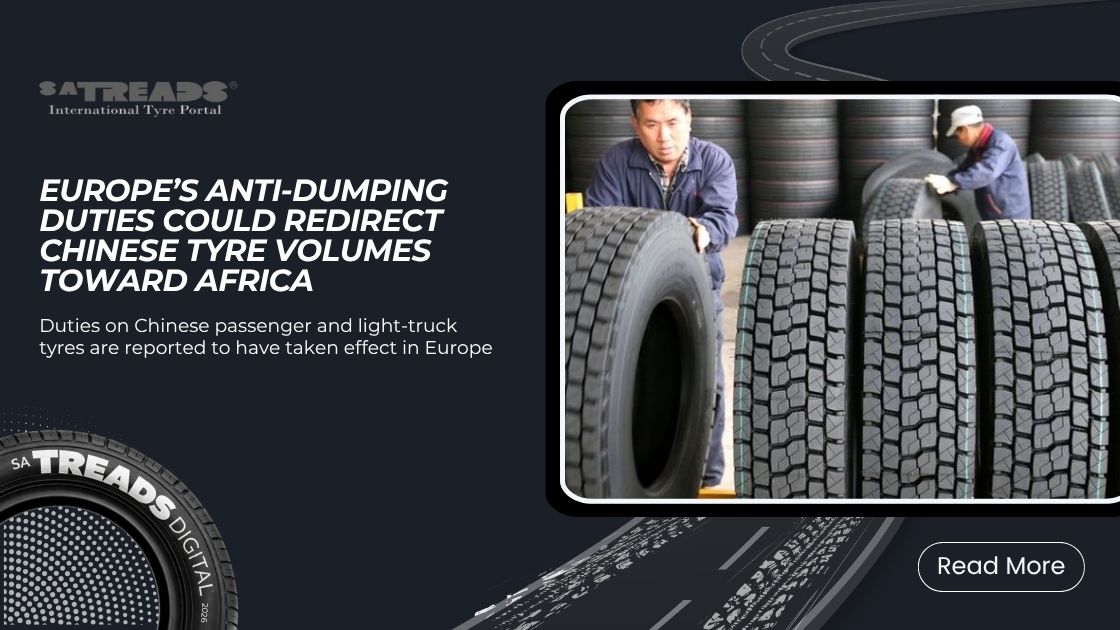
- Duties on Chinese passenger and light-truck tyres are reported to have taken effect in Europe
- The move could reshape pricing, sourcing and inventory flows across multiple markets
- Southern Africa may need to watch for redirected volume and downstream price pressure
Europe’s move to impose anti-dumping duties on Chinese passenger-car and light-truck tyre imports could have consequences well beyond the region itself, with potential knock-on effects for trade flows into Africa.

According to market coverage citing the European Commission decision, the duties took effect last week, prompting renewed attention on how global tyre supply may be redirected if access to the European market becomes more constrained for Chinese producers. Analysts at Citi said the development should improve sentiment for major tyre makers including Michelin, Goodyear, Continental and Pirelli.
For the tyre industry in Southern Africa, the bigger question is what happens next.
Why this matters beyond Europe
When a major market changes its trade position, inventory rarely stands still. If Chinese volumes are squeezed out of Europe, those tyres may need to find alternative destinations, and that could place increased focus on Africa and other price-sensitive markets.
That does not automatically mean an immediate flood of product into Southern Africa, but it does raise the likelihood of closer competition, sharper pricing moves and renewed pressure on importers, distributors and local manufacturers.
A market South Africa should watch closely
For South African tyre businesses, the issue is not only about global politics or European regulation. It is about whether international trade action could eventually influence local availability, replacement pricing and competitive dynamics in the months ahead.
If redirected volumes do start moving into African markets, dealers and importers may feel the effects first, particularly in the passenger and light-truck segments where price sensitivity is high and imported product already plays a major role.
The SATreads angle
This is the kind of development that may start as a European trade story, but could quickly become a Southern African market story.
The next step is to test the theory locally: are South African importers, wholesalers and dealers already anticipating changes in supply patterns, pricing pressure or brand competition as a result of Europe’s anti-dumping action?
Source note
At this stage, the story is based on secondary market coverage citing the European Commission decision:
WSJ market note, 8 July 2026