In the previous edition, we explored the challenges facing South Africa’s remaining tyre manufacturers and their call for stronger protection against unfair imports. Now, the Tyre Importers Association of South Africa (TIASA) offers its perspective. While agreeing that illicit trade is harming the industry, TIASA argues that the real issue is not anti-dumping duties, but the failure to enforce existing legislation. In this follow-up, they explain why they believe stronger enforcement—not higher tariffs—is the key to creating a fair and competitive tyre market.

Following our feature story in the previous edition, which highlighted the plight of our three remaining local tyre producers, the Tyre Importers Association of South Africa (TIASA), representing South Africa’s legitimate importers who play by the rules (Apollo, Pirelli, Michelin, Treadzone, Maxxis, Tubestone, Reivilo, Vaal Tyre Centre, Stamford, Auto & Truck Tyres, TiAuto, Transafrica, Tyre & Wheel), felt compelled to add their thoughts and concerns to the matter. Chairman, Charl de Villiers was their designated spokesman.
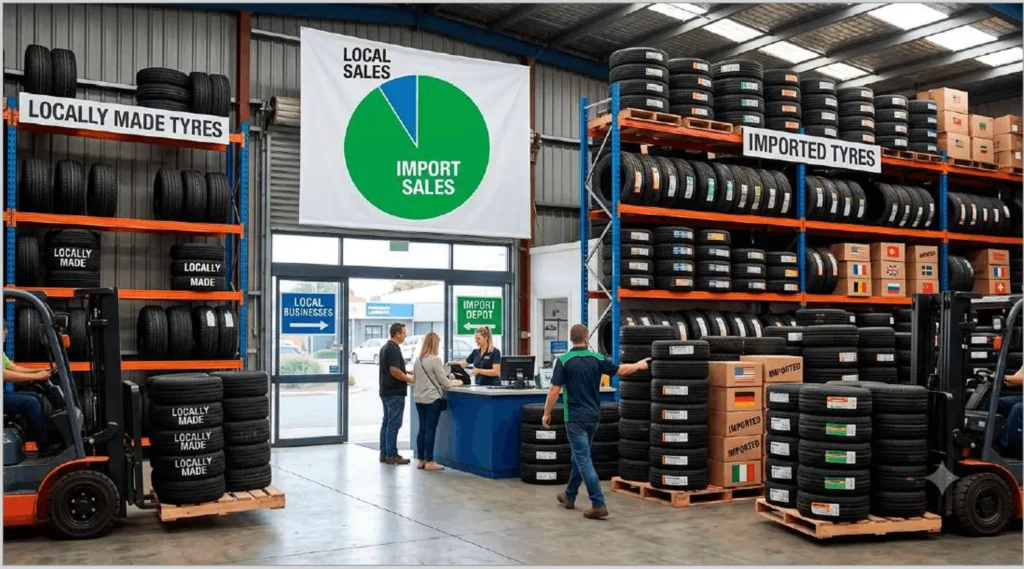
There is one issue on which both local tyre producers and legitimate importers appear to agree: Unfair trade practices are damaging the domestic tyre sector. They may be on opposite sides of the camp, but businesses that rely on imports (mainly from the Far East), to service their customers, are finding it equally difficult to compete. And this, despite that imports have now overtaken the sale of locally made tyres, accounting for over 60 percent of market share.
So, what is really going on?

Our previous story on the challenges facing South Africa’s remaining three local makers revealed their call to the relevant government bodies to provide them with the right support structures to continue operating and protect local jobs. They pointed to the significant and growing influx of tyre imports from China, emphasising the need to address the loopholes that were enabling South African importers to pay a mere fraction of the required anti-dumping duties in place, or even evade paying anti-dumping duties altogether, by importing via China’s closest neighbours (country hopping).
Consequently, the SATMC applied to ITAC to review this practice, in hopes of implementing similar anti-dumping duties on tyres coming in from Thailand, Cambodia and Vietnam. According to TIASA, although they share the local producers’ frustrations on unfair trade practices that are wreaking havoc on the market, the focus on anti-dumping duties as the primary remedy has proven to be the wrong tool for the job. “I hate to admit it, but we predicted this and brought it to ITAC’s attention in our submission during the investigation, stated Charl de Villiers. According to TIASA, the core problem was, and remains, the failure to enforce existing legislation.
Before the anti-dumping application was tabled, they claimed, TIASA had, on numerous occasions, provided SARS with intelligence via the Tyre Industry Forum, (a body of which SATMC is also a member), identifying importers whose market pricing suggested they were not declaring their goods correctly. “The evidence was visible in the marketplace to anyone paying attention,” continued de Villiers. “Our concern, then and now, is straightforward: imposing higher duties does not change the behaviour of bad actors. Those on the fence are nudged toward under-declaration as margins compress.
Those already under-declaring simply continue. The only parties harmed by higher duties are the legitimate importer, and ultimately, the consumer. Those that stand to gain is government and the local producers who are able to increase prices. (Prices increased roughly three-to-four times during 2025, depending on brand and tyre category), through separate manufacturer announcements). “The most persistent form of illicit trade in our industry has nothing to do with anti-dumping margins, reiterated de Villiers. “It is the deliberate underdeclaration of import values, weights and tariff classifications by a minority of importers and their clearing agents.” De Villiers explained: “SARS recently presented with a striking example at an industry forum meeting: an importer declared the weight of a container of truck tyres as 1kg, whereas the actual weight should have been approximately 13 000kg.
The waste tyre levy on that shipment should have been R29 900. Instead, only R2.30 was paid. The competitive advantage gained through that single shipment was between three and four percent over legitimate importers. Alarmingly, when SARS approached the clearing agent in question, he simply put it down to a capturing error, paid a small fine and that was the end of the matter. Which begs the question. How many of these shipments are being missed? “No anti-dumping margin addresses this! If anything, the higher the duty environment, the greater the incentive to under-declare,” said de Villiers. A simple solution to this, according to TIASA would be to cross-reference all shipment declarations against the Bill of Lading weights supplied by the shipping lines.
This data is already in SARs’ possession as part of standard clearing documentation and given the precision require in load distribution aboard vessels, the likelihood of legitimate weight discrepancies is near zero. This one step could substantially close the loophole. Allegedly, the industry has repeatedly requested that importers found guilty of under-declaration or duty circumvention be publicly identified, but because the POPIA Act currently prevents SARS from sharing this information, offenders pay administrative fines and return to the same practices.
So, what would need to happen to get around this? TIASA has proposed that a legal mechanism be brought into effect allowing for industry notification of proven corporate offenders, without exposing SARS to liability. “This would be a meaningful deterrent,” suggested de Villiers,.“It is so frustrating for our members as we continue to see these actors active in the market without any repercussions in how they go about their business.”
What of tyre-and-rim combinations?
TIASA does not share the SATMC’s view that tyre-and-rim combinations represent a material circumvention risk, claiming the data does not support this. According to TIASA the market has as natural ceiling on how many combinations it can absorb, further stating that consumers do not need new rims every time they replace their tyres. Therefore, they said, the practice is commercially self-limiting. What is more, while an importer may not legally demount and sell the components separately, a dealer or fleet operator faces no such restriction. “The importation of tyre-and-rim combinations has shown a steady decline from 2023 when it represented 25 percent of TBR imports. In 2024, importation declined year-on-year by more than 34 percent and again by a further 20 percent in 2025, which is less than what the industry imported in 2021.
Currently, tyre-and-rim combinations represent less than 11 percent of imported truck tyres. Therefore, this was never the needle-mover SATMC suggested,” countered de Villiers. He went on to say: “At an Industry Forum meeting in May 2025, TIASA presented SARS data highlighting a clear case of under-declaration of TBR tyres (tariff code 4011.20.26). This data showed one importer consistently declaring TBR tyres at $51 per unit, at a time when the cheapest available price from China was approximately $95. SARS acknowledged they were unable to verify the data and no action was taken. To date, one year later, nothing has changed. The administrative will – and the political will – to act, simply does not exist.”
Zero-rated anti-dumping factory causes confusion.
On this point, TIASA and the SATMC appear to agree, challenging the rationale provided by ITAC that a constructed value had to be used because a local market selling price could not be established for one particular factory. Explained de Villiers: “It is difficult to understand how one factory in China could not be assessed by the same methodology applied to all others.
ITAC’s failure to publish its calculations further compounds the issue. Transparency in these determinations is not optional if the system is to retain legitimacy. To this point, ITAC is now proposing sweeping changes to the International Trade and Administration Act (ITAA), which is a major concern for TIASA. “An important document submitted to ITAC by XA, (representing TIASA and other players), highlights all the shortcomings we see if the proposed amendments are implemented, and one can only hope that sanity prevails and that we are afforded the opportunity to consult with government on the proposed changes.” According to TIASA, this is a real concern, not only to our industry, but to all.
Should this be implemented, the Minister/ITAC could potentially do as they please without proper judicial review. Lack of disclosure threatens transparency, and secret agreements between government and applicants can only lead to questionable actions.
Country hopping, a frustration for all
When it comes to country hopping, TIASA share’s the SATMC’s frustration at the outcome of ITAC’s 18-month investigation into trade pattern shifts through Thailand, Cambodia and Vietnam. He echoed: “We believe there is sufficient circumstantial evidence that some Chinese producers rerouted production to avoid the dumping margin.
The failure to impose duties on those origins was a significant missed opportunity to level the playing field and reinforces the broader point: the antidumping instrument is only as effective as the investigative capacity and political will behind it.” Realistically, the question we should be asking is: Does a trade remedy exist globally that can counter what China has built? China has invested heavily in next-generation manufacturing infrastructure. In the tyre industry alone, there are factories in China operating with fewer than 100 employees, producing upward of 140 000 tyres per day, whereas South Africa’s three remaining local producers collectively employ approximately 4 500 people and produce 36 000 to 45 000 units per day.
Can anti-dumping duties manufacture competitiveness given the stark realities of the growth and influential power of this global economy? “ITAC has created a pricing floor that allowed local manufacturers to raise their sell-out prices in line with the cost increases borne by legitimate importers. The consumer paid more. The state collected more in duties. The illicit trade carried on as before.” Instead, TIASA believes the answer lies in smarter enforcement technology, trade facilitation reform and targeted legislative tools.
They insist they are not opposed to fair competition, nor to measures that protect legitimate industry participants from unfair trade. “We are, however, deeply concerned that the anti-dumping route consumed years of industry energy and government resources, delivering limited benefit, while the underlying enforcement failures that enable illicit trade, remain largely unadressed,” he said. In closing, de Villiers reiterated: “The SATMC’s frustration, as expressed by Nduduzo Chala, is understandable and mainly justified.
But the path forward is no to search for a higher or broader duty regime. It is to fix the pipes that are leaking. The tools exist. The data exists. What we need is the political will and administrative agility to deploy them. “TIASA stands ready to work with SATMC, SARS, ITAC and other players on implementing the enforcement mechanisms outlined above. A fair, competitive and compliant tyre market benefits importers and manufacturers alike. The is more that unites us that divides us, and the consumer’s interest in safe, affordable tyres must remain the common ground.”
In a nutshell, as strong advocates of the established Tyre Industry Forum, TIASA members are pressing for:
• Name and shame – those companies (importers and clearing agents) that are found guilty of duty circumvention must be fined and their names must be made public.
• Permits must be revoked if found guilty
• Communication: SARS and Industry must communicate as one to the consumers and industry to try and discourage illicit trade.
• Dealer buy-in: we need stronger buy-in from dealers that support illicit trade.
If we are not going to all play with our hands above the table we are on a slippery slope and a race to the bottom.